
Thanksgiving is the one week a year when gratitude gets a holiday. Many leaders will send a warm note to their team this week, and I hope they do. My worry is what happens the other fifty-one weeks.
Work is where gratitude goes missing. In a national survey commissioned by the John Templeton Foundation, people said they were less likely to feel or express gratitude at work than anywhere else. Sixty percent said they never express gratitude at work, or do it maybe once a year. Most of us thank the barista, the server and the person who holds the door. Then we go to work and forget.
I’ve felt the cost of that. I once spent years in a role giving everything I had, and when I left, the thank-you I hoped for never came. Others on that team did thank me, and one of them still acknowledges how much I did. It still means a lot when someone notices and says so out loud.
I’ve learned from that, too. I can’t work to chase thank-yous, and I own the boundaries I didn’t set. What I can do is help leaders see what a missed thank-you costs, so they keep the people who are giving them everything.
When you don’t thank people, they don’t feel seen.
We underestimate what a thank-you does
Researchers Amit Kumar and Nicholas Epley asked people to write a short thank-you note and predict how the recipient would feel. The writers consistently underestimated how happy and surprised the recipients would be, and overestimated how awkward it would feel. Many of us hold back because we assume the other person already knows. The research says to send it anyway.
A thank-you also changes what happens next. In a study by Adam Grant and Francesca Gino, people helped a student with his cover letter. When a second student asked for help, 66% of the people who had been thanked helped again, compared with 32% of the people who hadn’t. That didn’t surprise me at all. One of the most common employee relations situations I handled went the other way: a team stopped wanting to help a partner team that never showed appreciation and was consistently rude. People remember who thanks them, and they remember who doesn’t.
The workplace numbers agree. In a Glassdoor survey, 81% of employees said they’re motivated to work harder when their boss shows appreciation, compared with 38% who said a demanding boss motivates them. Gallup and Workhuman found that well-recognized employees are 45% less likely to leave within two years. Yet only 22% of employees say they get the right amount of recognition.
A missed thank-you cuts deeper with your best people
A missed moment of recognition stings for anyone. A high performer reacts more strongly and sooner, and they won’t put up with feeling unappreciated for as long as others will.
Start with what being good at your job often earns you. In a study led by researchers at Duke, people assigned more work to colleagues they saw as having more self-control, and people with high self-control reported feeling more burdened by coworkers relying on them. When the reward for great work is more work, and nobody says thank you, a high performer hears that they’re being taken for granted. They notice fairness, too. McKinsey points out that strong performers lose motivation when colleagues who aren’t pulling their weight receive the same rewards.
Then consider how quickly they can act on that feeling:
They have options. High performers tend to have the most options. When Gartner studied strict return-to-office mandates, high performers’ intent to stay dropped twice as much as average employees’. They react more sharply to signals about how they’re valued.
They go quiet first. In Corporate Executive Board research published in Harvard Business Review in 2010, one in three emerging stars said they felt disengaged, and about a quarter of high potentials intended to leave within a year. A high performer who feels unseen usually keeps delivering right up until the day they resign.
Each loss costs more. McKinsey cites research showing high performers are 400 percent more productive than average performers, and 800 percent more productive in highly complex roles.
They’ll say pay, and mean value. When a high performer resigns, the first answer is sometimes compensation. Ask enough questions, and you’ll often find they needed appreciation for what they delivered and didn’t get it.
This is where I’d push leaders a little further. I believe in pay for performance. The challenge is that it’s mostly invisible. If someone does twice the work of the peer beside them and earns a larger raise, they usually can’t see that difference, and neither can anyone else. Pay isn’t easy to see, so recognition has to do some of that work out loud.
That’s why I’d ask every owner a question: are you recognizing differentiated performance in a way people can actually see? A spot bonus tied to specific work and behaviors, a public thank-you that names what someone delivered, a stretch assignment that signals trust. Each of these says, clearly, “what you did stood out.” The fairness piece matters here, too. Recognition should follow clear, consistent criteria, so it reads as earned and not as favoritism.
And it has to keep happening. A one-time bonus is one trip. A promotion is one moment. High performers stay high performing when there’s something in it for them, consistently: thanks, recognition, support and the needs that matter to them personally. If someone is motivated by growth, what’s your plan to grow them? I’ve started thinking of it as each employee’s own hierarchy of needs, and I’ll share more on that soon.
A thank-you takes a few minutes. Replacing the person who quietly carried your year takes months, and some of what they knew leaves with them.
Make it specific, and look past the obvious
There’s a difference between “Hi team, I’m grateful for you” and this:
“Hey team, we’ve been through a busy fall, and we’ve reached results we haven’t had in years. I am so thankful for the extra work this team put into these results.”
The second one names the extra effort, connects it to a real outcome and gives the team the credit. High performers especially value that connection between their effort and the result.
Look past the most visible work, too. In my years as an HR business partner, I worked with good leaders who forgot to say thank you because they were always driving toward the next goal. The people they overlooked most were often the glue of the team, handling tasks on behalf of the whole group. Less visible work can still be a great deal of work.
Whose job is it to say thank you?
This is a question I come back to in almost everything I do: does everyone know who owns it? Recognition is one of the most common places where ownership goes missing. Owners assume their leaders are handling it. Leaders assume a team-wide email from the top covers it. The thank-you falls through the gap.
The direct supervisor’s thank-you matters, and so does yours. When Gallup asked employees where their most memorable recognition came from, 28% named their manager. Another 24% named a high-level leader or CEO, and 12% named their manager’s manager. More than a third of the most memorable recognition came from above the direct supervisor.
It’s also worth asking who holds leaders accountable for recognizing their teams. Most companies are good at holding employees accountable. Fewer set the same expectation for leaders. If recognition matters, make it part of what you expect from your managers and what you talk about in their reviews.
If you lead leaders, consider doing more than passing thanks down the chain. Send everyone a note on your own behalf, thanking them for the results. For a small business owner, that means a note to the entire team, in your own words. Your thank-you carries weight precisely because of who it comes from.
Thank the people who aren’t on your org chart
Some of the people who made your year possible don’t report to you at all. Think about the partners in IT, finance, operations or HR who answered your urgent request, the colleague in another department who covered for you during a crunch, and the vendor who rushed an order.
These are the people least likely to be thanked, because no one is formally responsible for recognizing them. A specific thank-you, copied to their manager, can mean more than you’d expect, and it makes the next favor much easier to ask for. This week, make your list longer than your direct reports.
When recognition becomes performative
One company I worked for made a significant investment in Customer Service Week every year. There were calls thanking people, and HR business partners and leaders handed out candy at the offices. Senior leaders made the rounds to visit the locations.
Nobody ever asked employees or middle management how the week went. I suggested a survey to my leader and my skip-level leader multiple times, and it never got traction. Meanwhile, mid-level leaders carried the pressure of making the week happen.
I believe the people involved meant well. Good intentions only go so far, though, once you know no one has asked employees or mid-level leaders what they want, and you still choose not to ask. That’s how recognition becomes more about the leaders than the team. Good recognition is meaningful for the people you’re recognizing, not the people doing the recognizing. If you want to know what would mean a lot to your people, ask them.
What it looks like when it lands
One of my favorite recognition moments came from partnering with a senior business leader, a friend and colleague of mine who carried an enormous load that year, at times as the only leader at his level in the group. He was the kind of leader anyone could call, whether or not they reported to him.
Together, we created a medals event for every leader in the organization, each with a superlative for the specific value they brought to the business. He was named the Partnership Pioneer, and no wonder: he’s a fabulous partner. We emceed it together, and while we might have put the slides together, the energy and excitement he brought to the call really made the event special for those leaders.
The following year, leaders were still asking about that event and wanted to do it again. That’s how you know recognition worked. People bring it up long after it’s over, and it was so rewarding to know how much it meant to them.
How I’m building this into the Concierge
The Concierge is the app I’m building for owners who carry HR on top of everything else. Recognition lives in Standing Ovation, the ballroom, where shout-outs, spot awards and company awards fill a trophy case the whole team shares.
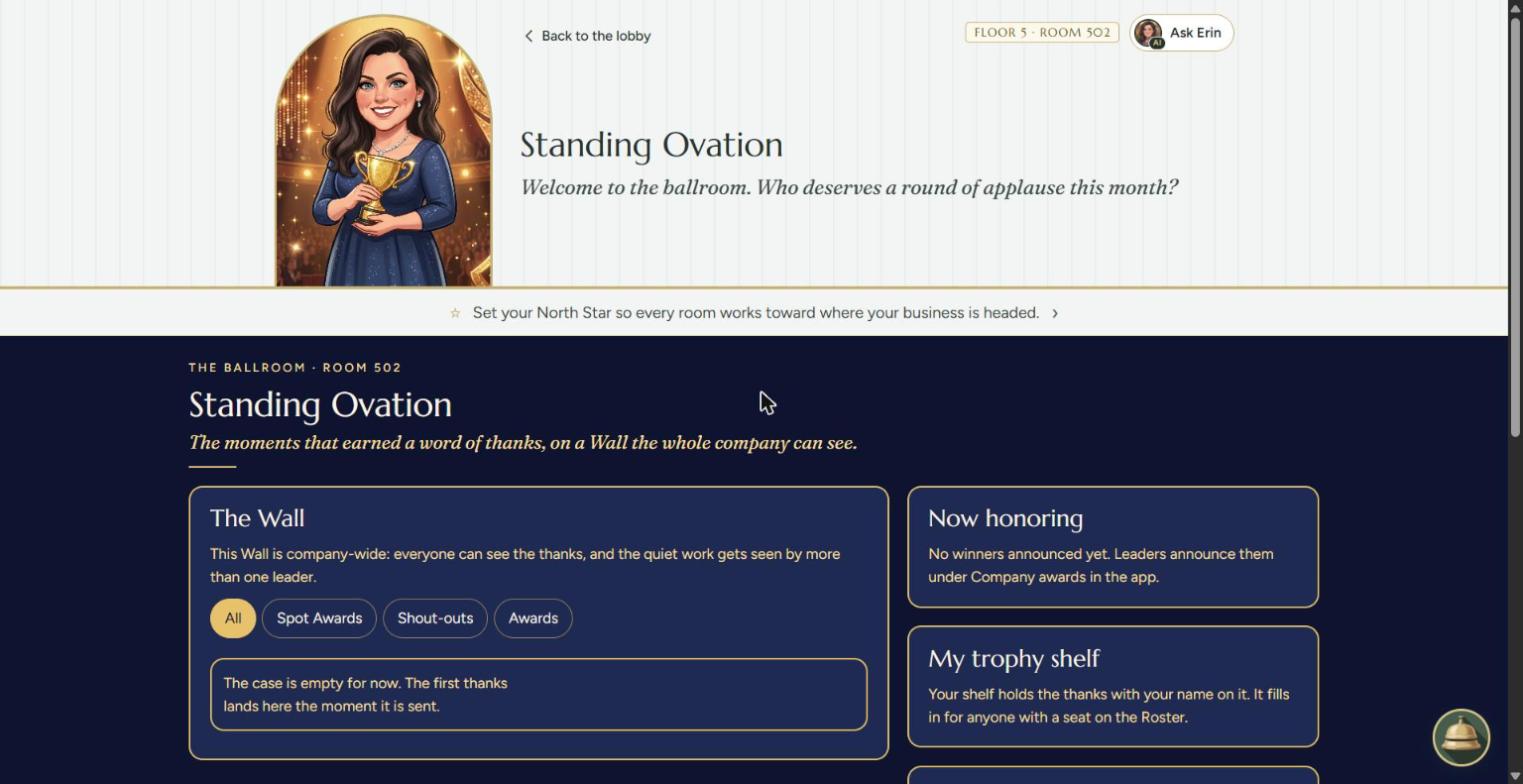
The heart of it is Ask Erin, the AI guide who walks owners through every room. Today, when an owner mentions a win, Erin notices and suggests turning it into a thank-you. In our sample company, the owner shares that a supervisor’s 2nd shift team covered two call-outs and still hit every holiday order. Erin calls it a win worth celebrating and offers to take her straight to Standing Ovation so the thanks reaches the supervisor and her whole team.
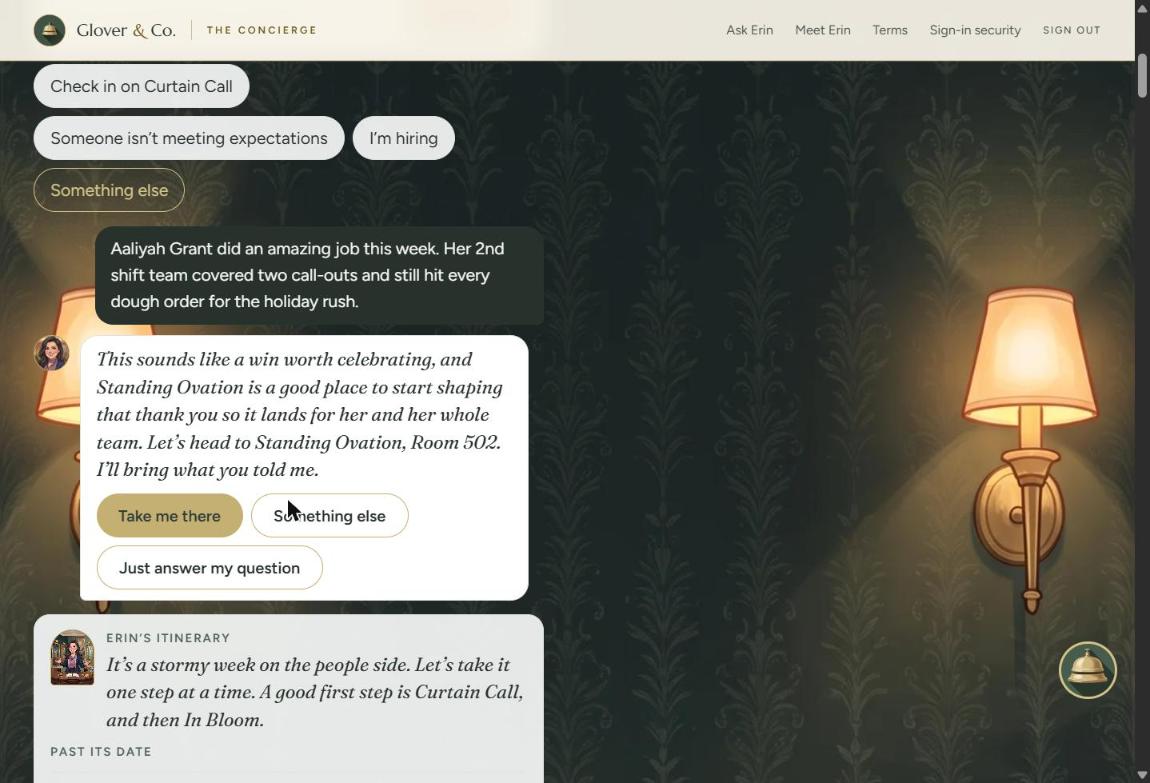
Here’s where I’m taking it. The rooms in the Concierge talk to each other, and I’m designing Ask Erin to move between them so the right person gets thanked at the right moment:
Curtain Call, the performance room. A high performer earns a Showstopper rating. That’s a great person to recognize that year, especially if they did something unique that isn’t normally part of their job.
The Booking Desk, the capacity room. It shows when your team is in a busy stretch. That’s the moment to tell them you see their hard work and appreciate the outcomes they’re delivering.
Covering Your Bases, the critical skills room. It shows who might be a single point of failure and who is carrying a heavier load than their peers. This is often where you find the glue person. They may not show up as a top performer, because they don’t have time for a big assignment while they handle all the small ones on everyone’s behalf. I’m designing Erin to notice them.
I’m also building Standing Ovation to ask each person how they like to be recognized, so you thank people the way they want to be thanked.
What to do Monday morning
Take a look at the recognition you’ve given your team in 2026, starting with your best people. If there hasn’t been any yet, that’s an issue, and I’d get on it right away. While you’re at it, add the partners outside your team who made your year easier.
If you’re the owner, send the whole team a note this week thanking them for what they accomplished this year.
Then make a plan for 2027: who owns recognition, how you’ll recognize your team and your partners, and a cadence for doing it. The thank-yous that show up all year are the ones that feel authentic.
If you’d like help building that plan, want to talk it through, or think the Concierge could help, I’d love to hear from you. I’d be glad to show you how the Concierge can support your recognition and the rest of your HR work, too.
Happy Thanksgiving.
Sources: John Templeton Foundation national gratitude survey, as reported by the Greater Good Science Center; Kumar & Epley, “Undervaluing Gratitude,” Psychological Science (2018); Grant & Gino, “A Little Thanks Goes a Long Way,” Journal of Personality and Social Psychology (2010); Glassdoor Employee Appreciation Survey (2013); Gallup and Workhuman, “Employee Retention Depends on Getting Recognition Right” (2024); Gallup, “The Importance of Employee Recognition: Low Cost, High Impact”; Koval, vanDellen, Fitzsimons & Ranby, “The Burden of Responsibility,” Journal of Personality and Social Psychology (2015); Gartner HR research on return-to-office mandates (2024); Martin & Schmidt, “How to Keep Your Top Talent,” Harvard Business Review (2010); McKinsey & Company on talent productivity.