
I once sat in a meeting where we raised a pattern: operations managers weren’t documenting performance issues the way we expected. The instinct in the room was to assume operations managers weren’t doing their jobs. It felt like an unfair conclusion, reached before anyone had asked a single question.
I wish we had asked a couple more questions about what was already on those leaders’ plates. If we had, we would have learned that many of them led much larger teams than leaders in other parts of the organization. Some of their teams were spread across several locations, each with its own HR guidance, its own leadership guidance and its own culture. That dynamic deserved more consideration than it got.
You don’t need an HR department to have this problem. If you have two supervisors, you have it.
I promised myself I’d never lead or partner that way. When something isn’t happening, my first question is why.
My theory: documentation is a series of decisions
In my experience, leaders do want to give feedback. They want to help their teammates get better, or move on if the role isn’t right for them. The usual response when documentation doesn’t happen is more direction: another reminder, another training, another deadline. It rarely moves anything.
Here is my theory. Documentation requires a series of decisions that leaders often don’t have enough context to make, and so the decision sits. Before a leader writes a single line, they have to answer several questions. Is this serious enough to write down? Is it fair? Is it consistent with how others have been treated? Is it time to escalate? The leaders who stall are often the most conscientious ones, the leaders who want to cross every T and dot every I. Without the context to answer those questions with confidence, they wait.
The research is consistent with this. Psychologists who study decision avoidance have found that when a choice feels uncertain and regret is possible, people tend to put it off. In a large survey by the U.S. Merit Systems Protection Board, federal supervisors who held back from a warranted action most often cited the time it would take and doubts that leadership would back them. Federal rules differ from a small business’s, but the pattern will sound familiar.
My theory doesn’t explain everything. Plenty of leaders have the context and still avoid the hard conversation, and I’ve seen that often in my years in HR. Not everyone is trained for conflict, and some people really struggle with it. Others feel unsupported, especially at small businesses, where a first-time leader may have no mentor and no one to practice with. Context and support are two different needs, and leaders usually need both.
Written to apply broadly
Many organizations keep their policies vague on purpose. A broad policy can apply across the entire business, and once you make a rule, everyone has to follow it. A typical performance policy says that if your performance is struggling, as determined by your leader, you’ll be placed on corrective action, and then it lists the steps and severity levels.
That works only if each part of the business fills in the detail. In practice, every location, team and leader adds their own influence, and standards drift. Consistency is one of the clearest markers of a fair process, and it’s very hard to deliver when every leader is filling the gaps on their own.
Inconsistency carries a real cost, too. In Connecticut, breaking a company rule counts as willful misconduct for unemployment purposes only when the rule is reasonable and uniformly enforced (Conn. Gen. Stat. § 31-236). If one leader writes up an attendance problem and another lets the same problem go, two teams are being treated differently under the same policy, and nobody decided that on purpose.
Accountability that only runs one way
There’s a pattern I’ve seen consistently. Policies give pretty clear guidance on how to hold an employee accountable. They almost never say how a leader should be held accountable for enforcing that policy.
The same gap shows up with company values. Organizations name the core behaviors, competencies or pillars they expect everyone to share, yet I’ve never seen guidance on how to document a gap in those behaviors. Leaders are expected to model them, coach to them and enforce them, often with nothing written down about what that looks like. If we want leaders to act consistently, they deserve the same clarity we expect them to give their teams.
When HR becomes the barrier
At one organization, I helped develop an employee relations training for leaders who needed to document behaviors, beyond missed metrics. It used the situation, behavior, impact model. Leaders were asking for it. My business leader wanted it, because she wanted to see appropriate performance action in her organization. The training was ready.
Then it needed several layers of approval, and each one came with its own round of twenty questions. I felt stuck between a rock and a hard place. From the business’s perspective, I was the one holding something up. HR was slowing down the very thing the business was trying to achieve.
If I could say one thing to HR teams, it’s this: look at your policies and ask whether a leader could act from them alone. If not, make sure the detail exists at the business level and that leaders can get to it. Then look at your approvals. Does every leader in your business need to approve one action? Could one person with named responsibility for that policy make the call? Limit the approvals and add clarity where there isn’t any.
Make the right thing the easy thing
That belief shaped how I built The Concierge, my library of HR tools for owner-run businesses. The goal is to make the behavior we want the easiest thing to do, and to give leaders time back so they can focus on the business. The Concierge is an HR partner in an app. It works alongside the payroll you already use, and its guide helps you and your supervisors handle people situations the same way every time.
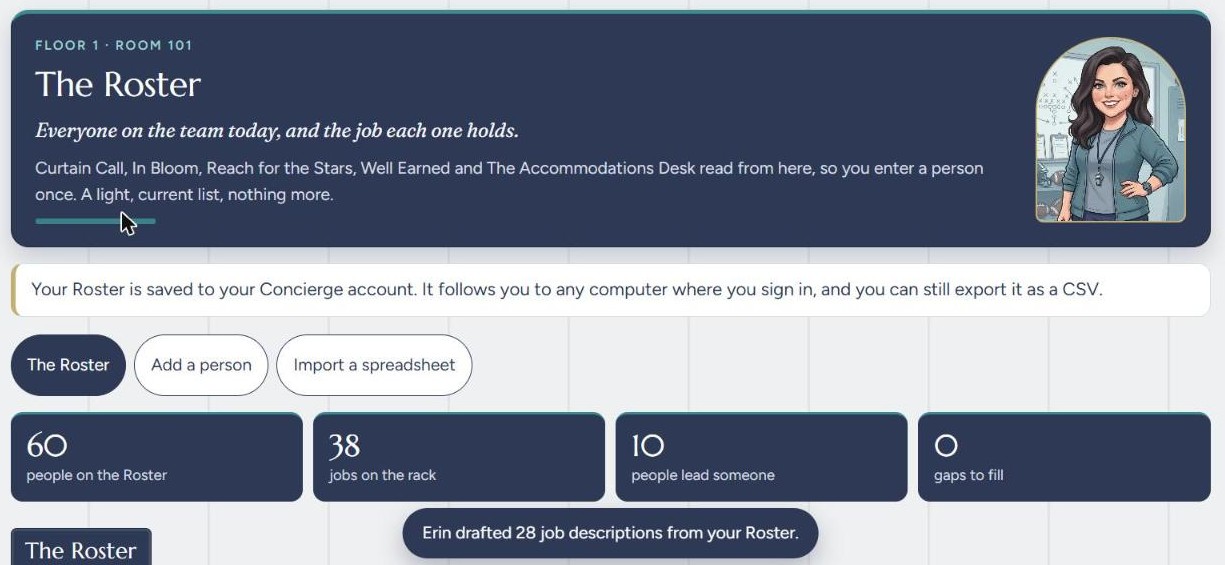
Performance doesn’t happen in a vacuum. It’s shaped by goals, one-on-ones, coaching, recognition and more, and context that stays stuck in one place leaves leaders guessing. In a great hotel, the front desk, housekeeping and room service all share what they know about a guest, so the guest never has to repeat themselves and the concierge always has the full picture. Every room in the Concierge works the same way. When an owner adds the team to The Roster, pasted straight from a payroll export, every room that needs that list gets it at the same moment.
It starts with the policies themselves. I’m building By the Book, the Concierge’s handbook builder, so that every policy includes three parts: the policy, what manager enforcement looks like and guidance for documentation. That way, the handbook will hold leaders accountable for enforcing policy and for setting direction aligned with the company’s core behaviors, alongside holding employees accountable.
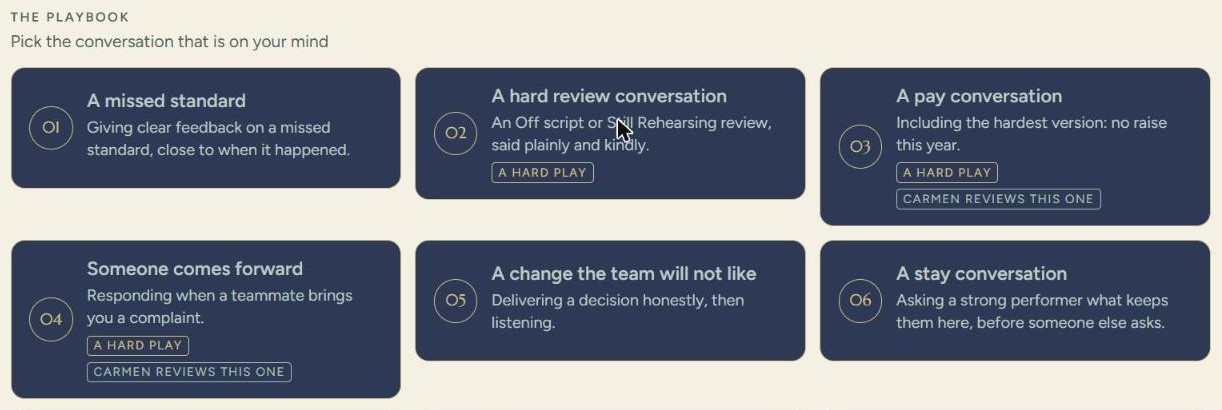
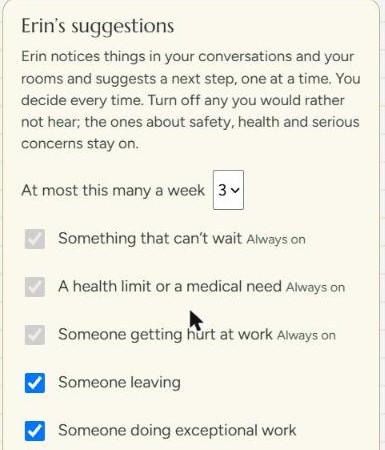
When a leader is facing an employee situation, Erin, my AI avatar inside the app, brings the context they’d otherwise have to hunt for. She reads from the same handbook and gives the same guidance to every leader in the company, and she can share how situations have been handled before. When a leader is dreading a conversation, they can rehearse it first in Game Plan, where Coach Erin plays the employee so they can practice saying it out loud and get feedback. No one has to lead alone. When a leader talks through a specific employee situation, Erin offers a short, dated note for the coaching log, and saving it takes one tap.
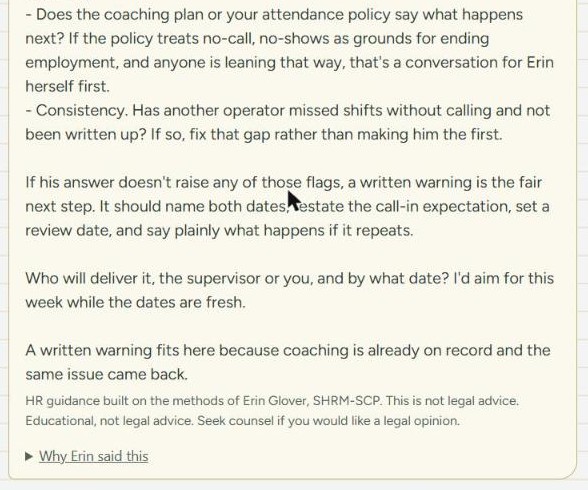
Erin recommends, and the leader decides. That’s the Glover & Co. philosophy on AI: keep judgment and discretion with people, and let the app handle the work that doesn’t need them. A growing number of states, including Connecticut, now have rules about employers using automated tools in employment decisions, and I expect that list to keep growing. In Connecticut, the employer still answers for the decision even when a tool helped make it. Most important, the buck needs to stop with the leader. A tool that made the call would teach leaders to lean on someone else for a decision that belongs to them.
If you’re the owner
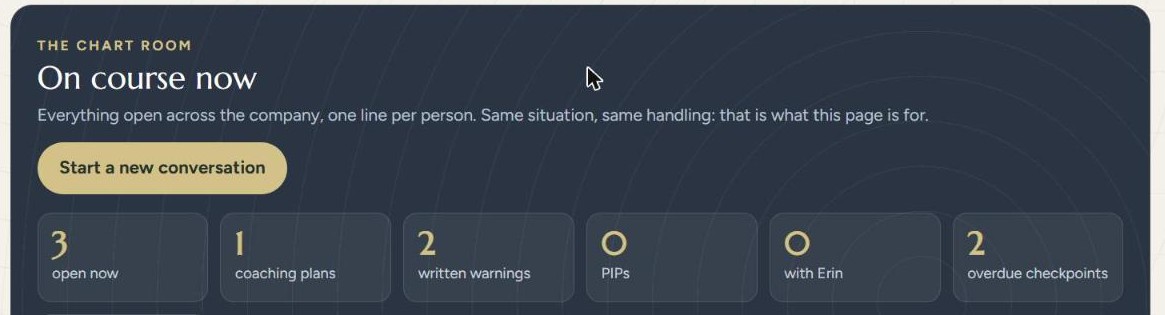
Whether you lead every person yourself or have a few supervisors, the same thing happens at an owner-run business with no HR. When something comes up for the first time, there’s no shared history of how it’s been handled. That’s when documentation matters most, both in case the situation escalates and so the next decision is consistent with this one. Keep a record of how you handled it. In the Concierge, that record stays in Erin’s memory of your company, so the next time a similar situation comes up, Erin (the app) can recommend the same approach.
One thing for Monday
This week, ask each of your supervisors how they would handle a second no-call, no-show. If their answers differ, you’ve found your gap, and it’s worth writing down one standard together.
If any of this sounds familiar, I’d love to talk with you about the Concierge. The web app is available now, and the iOS and Android apps are on the way. Before you ask your leaders to do more, ask what’s getting in their way. What would your leaders say?
Sources
Anderson, The psychology of doing nothing: forms of decision avoidance, Psychological Bulletin (2003)
U.S. Merit Systems Protection Board, Federal Supervisors and Poor Performers (1999)
Connecticut General Statutes, § 31-236, Disqualifications for unemployment benefits
Connecticut General Assembly, 2026 SB 5, Public Act 26-15 (bill status)